
A word of warning: this one is not for the faint of heart. Not because it contains anything disturbing, but because it is extremely detailed, written almost like an academic paper. That said, if you are a diagnostic technician or if you regularly deal with BMW diagnostic challenges, you may want to grab your caffeinated drink of choice, take a deep breath and dig into this exhaustive study by Hophy Ge, a diagnostician from Shanghai.
Here’s a little background info from the post for context. “BSD stands for Bit Serial Data interface. The name reflects its transmission method: data is not sent in parallel, but bit by bit in serial form. It is a single-wire data bus, with the BMW engine control unit acting as the bus master — DME on petrol engines and DDE on diesel engines — and it is used to control and monitor several power-management and engine peripheral components.”
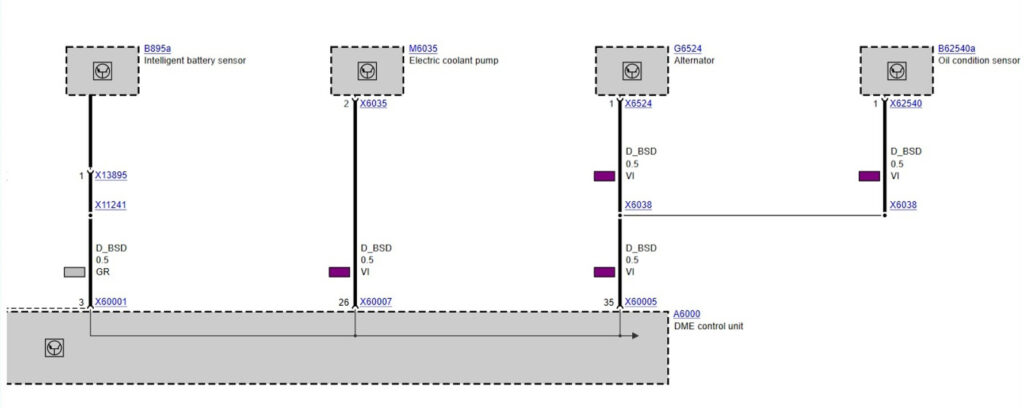
As Hophy notes, BSD protocol can look like LIN bus protocol: “Although BSD is often compared with LIN because of its single-wire topology, similar voltage levels, and master-slave structure, the waveform does not behave like LIN when examined closely.” So, if you are troubleshooting network comms issues regularly, at a minimum this article is worth stashing away for future reference. Plus, knowing that many technology innovations that start on European vehicles often migrate to US or Asian vehicle designs, this technology may soon be coming to a Chevy near you.
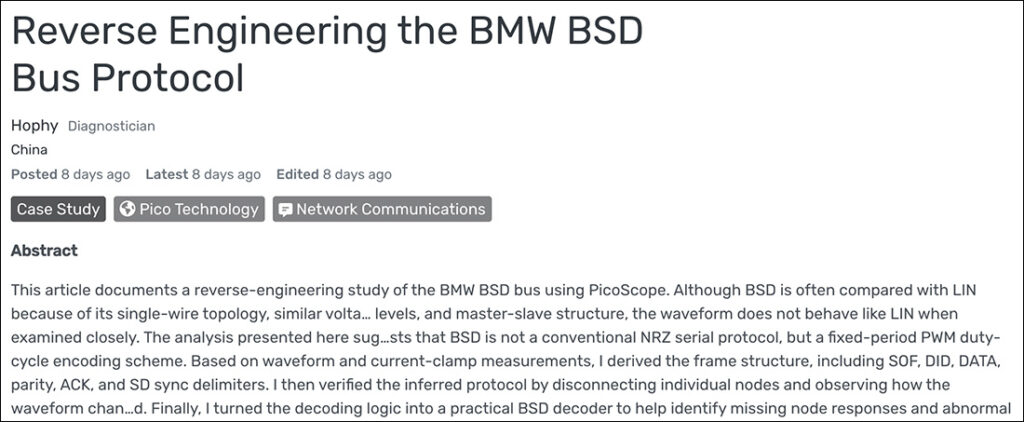
To see the original post at https://diag.net, click on the above Button or click here. To access complete forum posts or participate in the discussion requires a membership to the site. There are several membership options available, about which you can learn more here.
About Diagnostic Network
Diagnostic Network is an online community of industry professionals and leading industry stakeholders coming together to create the resource to support technicians of today and tomorrow. With your help, we are building a wide, bi-directional communication path between top level diagnosticians and the leading providers of tools, equipment, knowledge, service information, OEMs, and education solutions in order to provide a deeper understanding of the needs and wants of the top level diagnosticians. We hope to inspire the rest of the industry in order to reduce the ever-increasing skills gap. Learn more at Diag.net