


In the last few weeks, we have worked a major tool show and delivered several sales presentations to large customer sales teams. One thing that struck us was how sticky certain misconceptions are when it comes to battery service equipment and managing vehicle electrical systems. Some of these inaccurate assumptions seemingly just won’t die. But, this month, we’re doing our best to put them to bed.
Misconception #1 – “With my jump starter, don’t I need to worry about battery memory?”

This one is super common. If you’re old enough, you’ll likely remember being told, for instance on one of your first cell phone, not to put it on a charge cycle if the battery was above a certain charge state, because it would reduce the total battery capacity for future charge cycles. This may have been true for cell phone batteries in the mid-1990s, but it most definitely does not apply to Jump-N-Carry and Booster PAC jump starter batteries, whether they be AGM lead acid batteries or lithium batteries.
In fact, quite the opposite is true. The worst thing you can do for the health of your jump starter is to allow it to sit in a heavily discharged state for any period of time. In the case of AGM-powered jump starters, doing so will accelerate the natural sulfation process that takes place in all lead acid batteries. In lithium-powered jump starters, doing so risks the battery further self-discharging over time to the point where the Battery Management System (BMS) won’t allow a recharge to occur, to protect the battery from entering a dangerous state.
With both Clore jump starter battery types, there is no risk of memory issues as a result of charging them too often or as a result of charging them when their State of Charge (SoC) is already high. So, as we like to say, “Charge Early and Charge Often.” Our AGM-powered models are good for, on average, 750-900 recharge cycles, while our lithium-powered models are good for, on average, 2000+ recharge cycles. So, the potential damage of stemming from not charging often enough (sulfation, degradation, discharge beyond a recoverable level) far outweighs the risk of using up too many charge cycles. Soo please, charge your jump starter.
Misconception #2 – “When charging, does battery type really matter?”
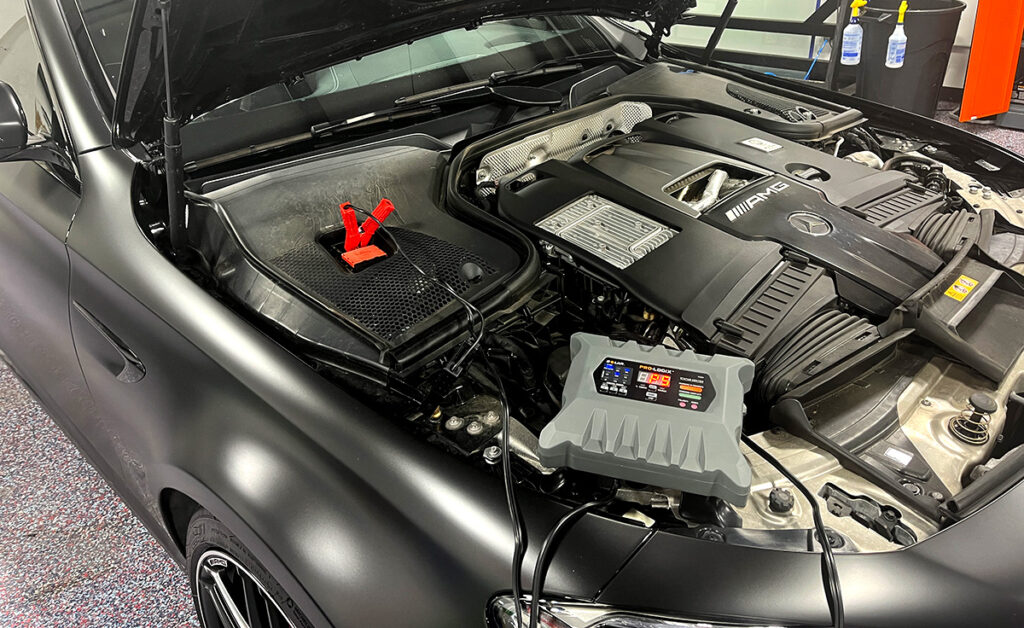
Quick answer – absolutely.
Let’s start with lead acid batteries. There are many different varieties, but we’ll focus on two, which are the primary ones that you’ll see in vehicle applications: Flooded Lead Acid/Maintenance-Free Flooded Acid and AGM/Spiral Wound batteries. You might say, “Hey, they’re all lead acid batteries, what’s the big deal?”
The reality is that these different batteries have different needs when charging. In all honesty, the Flooded Lead Acid battery is quite forgiving when it comes to charging energy. You can charge it with a 30-year old charger, take its voltage north of 16V and, most of the time, it’ll take a lickin’ and keep on tickin’. This is not true for AGM and Spiral Wound batteries, where specific charge parameters be must be followed, which includes a multi-stage charging process and tight control of voltage. Failure to meet either of these needs will reduce battery lifespan and risk a no-start event over time.
We’ll add a quick note here on deep cycle and marine batteries. These batteries can be either of the Flooded or AGM variety, so the construction drives the charging profile choice, not the deep cycle designation.
It gets even trickier with lithium batteries, where each different lithium battery chemistry has different charging parameters, which if not followed, could result in battery damage or even fire. The good news is that the vast majority of lithium batteries used in vehicle starting and power applications are Lithium Iron Phosphate (LiFePO4/LFP) lithium batteries. That’s why all PRO-LOGIX chargers that include a lithium battery charging profile are specifically optimized for this lithium battery type. But, to follow best practice, it’s important to confirm the lithium battery type before charging to ensure that your charger is properly matched to the battery type under service.
Misconception #3 – “Isn’t battery repair mode a fake marketing concept?”
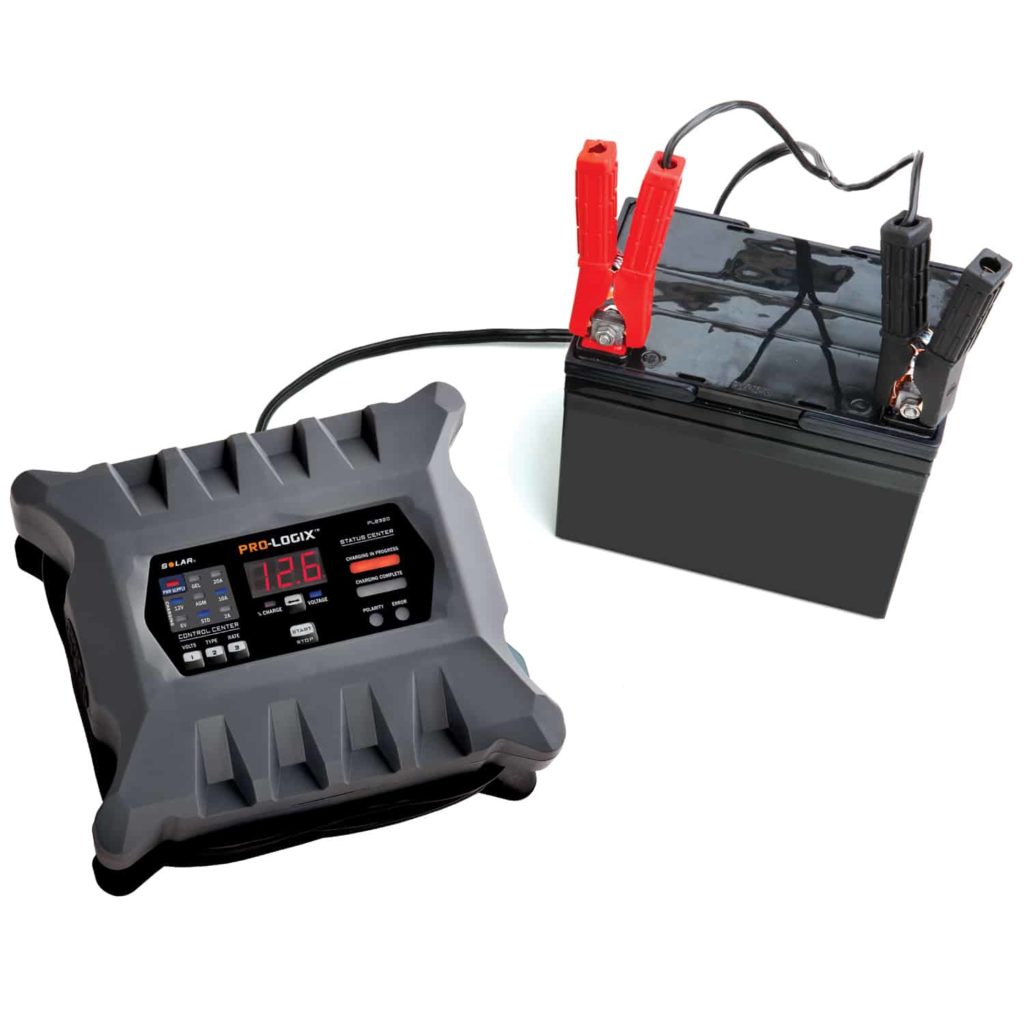
Not necessarily. Of course, we are referring to a quality battery charger when we say that Battery Repair Mode can be very effective when a battery has seen suboptimal usage patterns, hasn’t been regularly charged or has otherwise been pushed into a stressed state. As we noted under #1 above, sulfation is a natural process that takes place in a lead acid battery starting from the moment it is formed. Certain factors can speed that process (letting your car sit in the driveway unused for a 9-month stretch) and other factors can slow it, including servicing the battery regularly with a quality battery charger.
For instance, PRO-LOGIX battery chargers and maintainers feature an automatic Battery Repair Mode that requires no operator intervention. When a PRO-LOGIX charger is connected to a battery and a charge cycle is started, it first enters an Energizing Phase in which it sends energy to the battery and assesses how the battery is receiving/accepting that energy. If, during this Phase, the charger senses the presence of battery sulfation, it will automatically commence a Battery Repair Mode in an attempt to “shake” the sufation from the battery plates and restore the battery’s full energy potential. Then, once the battery reverts to accepting energy in a normal fashion, the PRO-LOGIX charger will automatically switch back to the standard charging routine for the battery type chosen at charging set-up.
This process can be extremely beneficial. Regular charging with a quality battery charger, such as PRO-LOGIX, can restore battery reserve capacity and extend battery life by months or years. At our recent show, we cited the case of a prototypical customer with a cottage. Usually, this customer would have a significant battery investment in their life, with boats, personal watercraft and more. If those batteries are not properly charged and maintained, especially in the off-season, they likely would need to be replaced after just a few years. But, regular charging with a Battery Repair Mode-equipped charger could potentially extend the replenishment cycle by an extra year or two versus not proactively charging them, which means very real savings.
Misconception #4 – “This low power charger / power supply is good enough to support reflashing in my operation.”

We hear this one all the time. First, let’s cover the facts. When it comes to module reprogramming/reflashing, every vehicle manufacturer (OE) specifies a power requirement in terms of both voltage and current. For this one, we’ll focus on current. We know of no OE current requirement below 55 amps and, with late model vehicles, most now set the floor at 70 amps. That means that a 20A, 25A or even a 40A power supply is insufficient to meet OE requirements for power delivery while supporting a module reprogramming event.
What does this mean in the real world? Historically, the OEs often specified a current requirement in excess of what was typically needed. This meant that a 20 amp power supply might be enough to support reflashing on a 2015 domestic vehicle. But, it was never within OE spec. Just like vehicle complexity never goes down in each successive model year, power demand is always climbing. That means that what you could get away with four years ago isn’t going to cut it now. In addition, consider the consequences of a failed reflash. These include a range of unpleasant outcomes, from the lost time of having to restart a programming event over from the beginning (best case scenario) to a bricked module that has to be replaced at considerable expense (worst case scenario. So, make sure that you have the right tool to support your diagnostic work by ensuring you meet the power requirements of the makes and models that you service.
Misconception #5 – “With so much power available, won’t that reflashing power supply overcharge the battery”
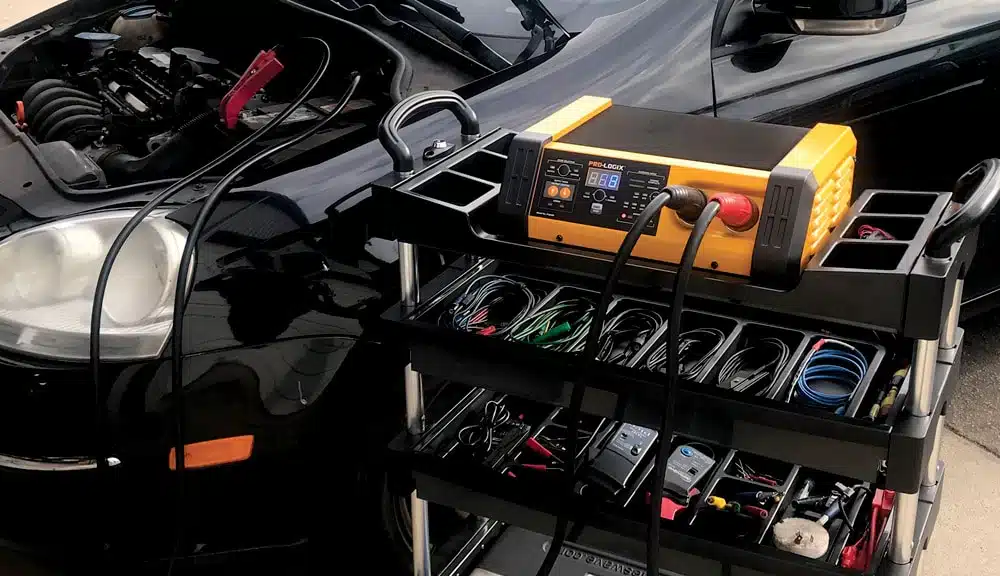
We got this one quite a bit at our recent tool show. When it came up, we backtracked to explain how the power supply (PS) function works in PRO-LOGIX models. When engaged in PS Mode, the unit is goal seeking to maintain the vehicle’s electrical system at a specific voltage level as indicated by the OE for that application. In the case of our Flashing Power Supply Models, PL6100 and PL6850, the available voltage range is from 13.1-14.9V, in 0.1V increments. So, the unit will provide current, as needed, to maintain the operator-specified voltage level, for example 13.7V. If system demand is 8 amps, the unit provides 8 amps to maintain the system at 13.7V. If system demand jumps to 84 amps, the unit provides 84 amps. By managing to system voltage, we are never overpowering the battery and we are supporting the module reflash application exactly as the OE specifies and as the diagnostic technician need us to do.
As with all industries, in the automotive aftermarket, there are some misconceptions and false assumptions that just don’t seem to want to go away. This seems especially true when it comes to battery and electrical system service. Some of these misconceptions might stem from a set of facts that were once true, but are no longer the case. Others seem to come out of left field. Getting on the right side of these 5 misconceptions can help you bring greater efficiency and effectiveness to your daily operation.
How about you? Do you encounter situations where colleagues, customers or even the OEs themselves have it wrong? Are there ones that come up over and over again? We’d love to hear about it in the comments below as would your fellow readers.




2 Responses
Really informative , Thanks
Wayne Huebner
Huebner Tool Co
Jersey Village Texas
77040
Wayne – Thanks for your comment. We’re glad that you found the article helpful. Thanks again, Jim from Clore Automotive