For this Deep Dive, we are going to jump into what we mean when we say that our PRO-LOGIX chargers deploy a dedicated Battery Repair Mode when they encounter a problem battery that is not accepting power from the charger in a normal fashion. This is a critical function of a modern battery charger and one that can deliver great value to the operator.
First, let’s define the problem that Battery Repair Mode is designed to solve. Here’s how battery sulfation is explained at https://electricalampere.com/:
Battery sulfation is a condition where lead sulfate crystals form and harden on the plates of a lead-acid battery. Here’s what happens:
• During discharge, a lead-acid battery naturally produces lead sulfate.
• When recharged, this lead sulfate normally dissolves back into the electrolyte (sulfuric acid).
• If the battery is left discharged for too long or is undercharged repeatedly, these sulfate crystals do not dissolve. Instead, they harden and stick to the plates permanently.
This leads to sulfation of the battery, making it less efficient and sometimes completely unusable.
What does this mean in the real world? When a battery is not accepting power in a normal fashion and therefore not increasing its capacity fully as a result of receiving a charge, in most cases, it is due to the presence of sulfation on the battery plates. As we noted in an article last month, “Sulfation is a natural process that takes place in a lead acid battery starting from the moment it is formed. Certain factors can speed that process (letting your car sit in the driveway unused for a 9-month stretch) and other factors can slow it, including servicing the battery regularly with a quality battery charger.”
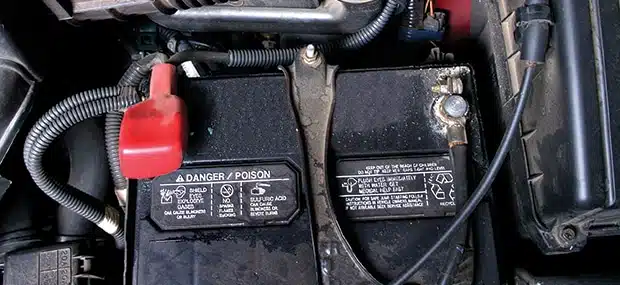
Over time, sulfation will accumulate on every lead acid battery, gradually reducing the battery’s capacity. In the early stages, it is not noticeable, as the difference between 96% of total capacity and 92% is not significant in terms of application impact. During the downward sulfation march, normal charging will bring the battery’s capacity back up to a useful (but decreasing) charge, but, normal charging will neither arrest nor reverse the downward march. Eventually, every battery reaches a point of no return, when so much sulfation has accumulated that charging the battery no longer adds back any useful capacity. When a battery has reached this state, charging results in a very fast rise in voltage but no corresponding increase in power. The battery looks like it’s charged, but the minute you apply a load to it, it is totally dead.
As noted above, one way to slow this downward march is regular use of a quality battery charger. This is helpful in two ways. First, regular charging, and keeping your battery at or near full charge as much as possible, slows the natural sufation process. Suflation is an opportunistic beast. It takes advantage of low charge condition over time, attaching itself to what is essentially an empty battery plate (if the battery is at low State of Charge – SoC) and accumulating more quickly due to the fertile ground that a low charge condition creates. As we have noted in other articles, preventive maintenance charging is very important on several levels, but in this case, because it reduces or eliminates the conditions that allow sulfation to accelerate.
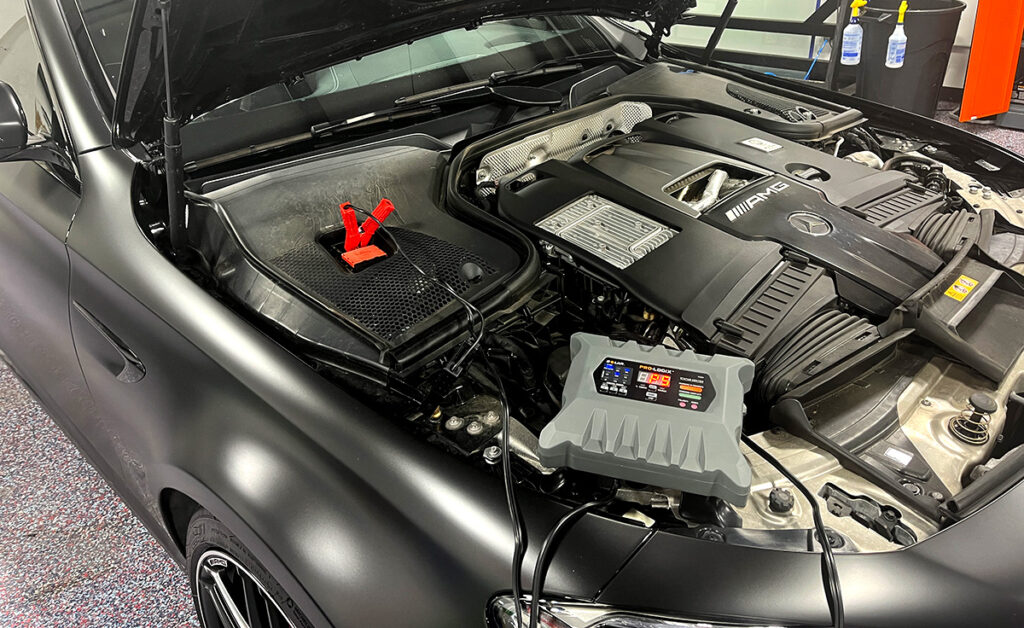
Second, using a quality battery charger, such as PRO-LOGIX, that deploys a Battery Repair Mode combats the build-up of sulfation within the battery. In our case, we deploy a specific routine designed to rejuvenate the battery, recondition its internal plates and shake off any lead sulfate crystals that have accumulated. An added benefit of the PRO-LOGIX Repair Mode process is that it is totally seamless – it requires no operator intervention. With PRO-LOGIX, the charger identifies the presence of sulfation during the first phase of the charging process (Phase 1 – Energizing) and automatically engages Battery Repair Mode. It will stay in this mode until the charger identifies that the battery is receiving power in a normal fashion and will automatically revert to the normal charging process to complete the charge.
Our experience, in both the lab and the field, is that our Battery Repair Mode is very effective in combatting battery sulfation, restoring battery reserve capacity and extending battery useful life. It is just one example of how PRO-LOGIX delivers a beneficial charge routine, no matter what battery type is under service, what the service environment is or what condition the battery is in at the start of the charging process – each PRO-LOGIX charging routine is unique and customized to the specific needs of the connected battery.
Your Trusted Battery Service Resource
Whether you are running a busy dealership, managing a general mechanical repair service operation or simply want to provide the best charging service to your family’s vehicles, PRO-LOGIX delivers charging effectiveness, efficiency and safety. Whether the need is effective fast charging in a service bay, extended charging of seasonal use vehicles or anything in between, PRO-LOGIX delivers, over and over again.
Below are just two examples of exceptional PRO-LOGIX charging solutions:
Model PL2320 6/12V 20/10/2A Battery Charger/Maintainer/Power Supply

The PRO-LOGIX PL2320 combines fully automatic operation and the ability to properly charge multiple battery types, making it the perfect charger to meet the needs of today’s and tomorrow’s professional technician. Intelligent, beneficial, safe and versatile – one charger does it all, from fast charging and battery repair to battery maintenance and long-term storage charging. The PL2320 charges and maintains virtually any lead acid battery type (Flooded, AGM, Spiral Wound, Marine, and Deep Cycle batteries), plus LiFePO4/LFP lithium batteries.
For today’s shop, there is a very real need for an up-to-date charger that is capable of supplying the clean power needed to perform a wide variety of diagnosis, repair and maintenance applications. The PRO-LOGIX PL2320 is an ideal charger/power supply for such situations. It utilizes advanced microprocessor technology to precisely deliver its power to the vehicle’s electrical system. This is exactly what the system wants when the charger is supplying power to maintain battery voltage during an on-vehicle repair or diagnosis of an electrical system issue.
• 6 and 12 Volt operation
• 20/10/2A charging rates
• 20A fast charge rate is ideal for charging large vehicle batteries
• 0-20A power supply mode to maintain vehicle voltage
• Advanced multi-phase charging process
• Services virtually all battery types, including LiFePO4 Lithium
• Temperature compensation for beneficial charging
• Forced start mode allows servicing of totally dead (0.0V) batteries
• Soft Start and Battery Repair modes manage problem batteries
• Enhanced maintenance mode for ideal long-term storage charging
Model PL2140 6/12V 4.0A Battery Charger/Maintainer
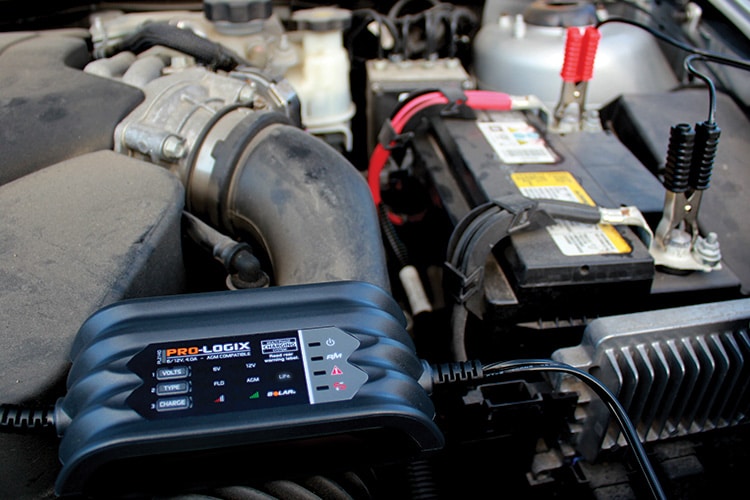
PRO-LOGIX Model PL2140 is a fully automatic battery charger and maintainer for both 6 Volt and 12 Volt batteries and systems, delivering a 4.0 amp charge rate. With its 4A charge rate, it can charge an extremely wide range of battery sizes, from ATVs and motorcycles to cars, trucks, commercial vehicles, and personal watercraft. The PL2140 charges and maintains virtually any lead acid battery type (Flooded, AGM, Spiral Wound, Marine, and Deep Cycle batteries), plus LiFePO4/LFP lithium batteries.
Each battery serviced gets exactly what it needs for optimal health. If the charger detects suflation, it automatically engages its Battery Repair Mode to restore battery health. If the connected battery is severely discharged, the charger will engage a Soft Start Mode to bring battery charge back to a normal level slowly and safely. Temperature compensation ensures that the battery’s charge is not adversely impacted by extreme hot or cold ambient temperatures. It is even capable of engaging totally dead (0.0V) batteries, with a Forced Start Mode, eliminating the “Dead Battery Dilemma.”
• 6 and 12 Volt operation
• 4.0 amp charge rate
• Advanced multi-phase automatic charging process
• Services virtually all lead acid battery types
• Services LiFePO4/LFP lithium batteries
• Forced Start Mode allows servicing of totally dead (0.0V) batteries
• Temperature compensation for beneficial charging
• Soft Start and Battery Repair modes manage problem batteries
• Enhanced maintenance mode for ideal long-term storage