

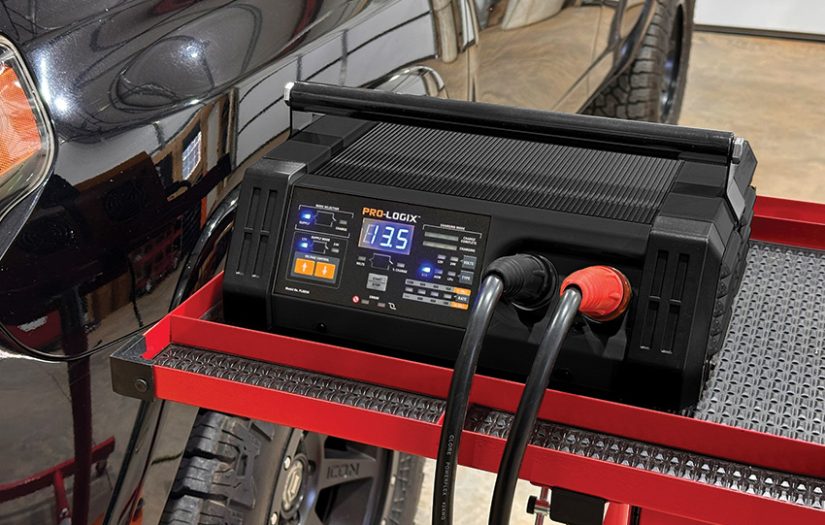
When it comes to vehicle reprogramming, there is one constant, and that is the need for a stable voltage environment to ensure a successful reprogramming event. No matter what your reprogramming tool of choice is, be it OE tool, aftermarket tool or pass-through device, each OE has a recommended target system voltage in which the event should take place. Not surprisingly, they tend to vary from make to make, and even can vary from model to model within one manufacturer.
Below is an updated table of OE-specified voltage environments for module reprogramming, developed and updated in partnership with our colleague Tanner Brandt, Diagnostic Technician, Technical Trainer, and Founder of Auto Diag Clinic. Where there is additional detail beyond the general spec, we have added it in the Comment column below.
We hope this is helpful as you tackle your programming tasks. Our PL6100 and PL6850 are excellent units that create an optimized electrical environment for module reprogramming, with super clean power delivery (<100mV of ripple) and operator’s controlled output, from 13.1-14.9V.
| Manufacturer | Recommended Voltage | Comment |
| Acura | above 12V | Ideal target is 13.5V |
| Alfa Romeo | 13.2V-13.5V | Not above 13.5V |
| Audi | 12.8V-14.2V | Must remain >12.5V; ideal target is 13.5V |
| BMW | 14.2V | 13.8V for lithium batteries |
| Buick | 13.4V | |
| Cadillac | 13.4V | |
| Chevrolet | 13.4V | |
| Chrysler | 13.2V-13.5V | Not above 13.5V |
| Dodge | 13.2V-13.5V | Not above 13.5V |
| Fiat | 13.2V-13.5V | Not above 13.5V |
| Ford | 12.6V-13.6V | **See Note. |
| Genesis | 13.5V | |
| GMC | 13.4V | |
| Honda | above 12V | Ideal target is 13.5V |
| Hyundai | 13.5V | |
| Infiniti | 13.5V | |
| Jaguar | 13.4V | |
| Jeep | 13.2V-13.5V | Not above 13.5V |
| Kia | 13.5V | |
| Land Rover | 13.4V | |
| Lexus | 13.5V | |
| Lincoln | 12.6V-13.5V | **See Note. |
| Mazda | 13.5V | |
| Mercedes | 12.5V-14.5V | |
| Mini | 14.2V | 13.8V for lithium batteries |
| Mitsubishi | 13.5V | |
| Nissan | 13.5V | |
| Porsche | 13.5V-14.5V | Ideal target is 14.2V |
| Smart | above 12.5V | |
| Sprinter | 12.5V-14.5V | |
| Subaru | 13.5V |
Do not exceed 14.0V – will cause programming to abort. |
| Toyota (except Supra) | 13.5V | Supra 14.2V |
| Volkswagen | 12.8V-14.2V | Must remain >12.5V; ideal target is 13.5V |
| Volvo | 13.4V |
Data provided is current as of February 2026
*Note: Most OEM’s also now have a recommendation that the vehicle module temperature must be no higher than 68F. It may be necessary to cool the vehicle down prior to programming.
**Note: Ford designates negative cable to be connected to engine or chassis ground. If both negative and positive battery cables are connected to the battery post, the battery monitoring system must go through a recalibration (the system calibrates the battery state of charge after about 8 hours of sleep time).




7 Responses
I am interest in purchasing unit, Please send details info prices range and where I can purchase. Thank you
Jerry – Thanks for your interest. Our products are sold through distibution and should be able to be purchased through the same suppliers where you currently purchase tools and equipment. Our products can be found in thousands of resellers in the US and Canada (as well as worldwide). In terms of physical locations, our products can be found at NAPA, Auto Value, Bumper to Bumper, Carquest, Advance Auto (Professional), and local independent auto parts stores. In addition, our products can be purchased from hundreds of online resellers as well. When looking to purchase from a physical store, because our products are more pro-focused, they are less likely to be in the retail area of a store, or even in a particular store at all. It is always best to call ahead to confirm availability. In most cases, if a store doesn’t have a specific item on hand, they can have it brought in by the next day. Thanks again, Jim from Clore Automotive
Excellent article, Thank you!
Interesting article – I use GYS battery support unit but they have one problem. If the battery is really low on a car you cannot force them to charge/support battery. I would be interested to know if this Clore unit has a way to force an output, even when the battery is really low. At the moment I have to use a slave battery on some jumper cables to fool the GYS into doing that (rather than maybe just pressing two buttons in combination to force the output).
Simon – Thanks for your question. Yes, we are able to “force start” the unit to override a low battery condition, both in PS Mode and Charge Mode. Of course, we recommend that the battery be ≥11.0V for any support function, at the beginning of the cycle, but feedback from many mobile diagnostic technicians convinced us to provide the option to override the low battery. Thanks again, Jim from Clore Automotive
Great quick-reference guide! I have 9 of your PL68xx units in our shop and they’re almost never sitting idle. We’ve found that 14.1 V seems to be the sweet spot for reprogramming.
Benjamin – Thanks for your input. It is much appreciated and I am sure that many of your fellow readers will get benefit from your insight. Thanks again, Jim from Clore Automotive