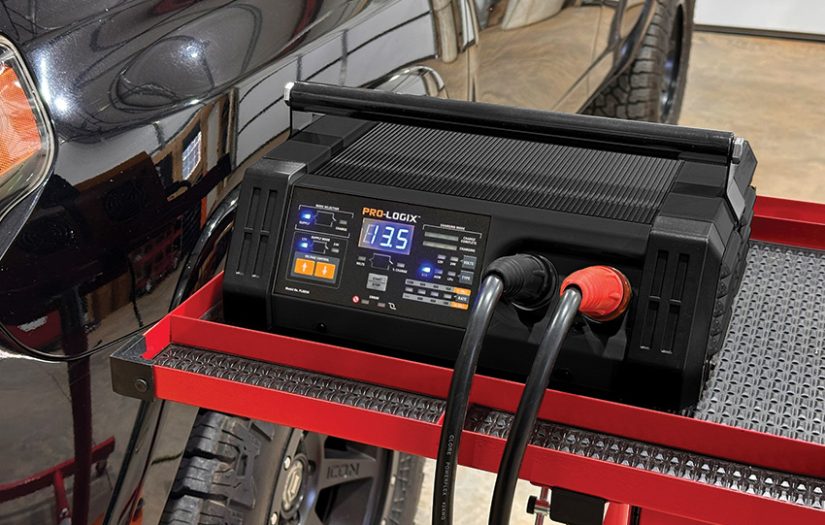
Written in collaboration with our colleague Tanner Brandt.*
A seemingly growing topic here at Clore and with our customers is, “What happens when a vehicle’s system voltage drops when programming/reflashing is in progress?” We often get calls from repair shops and our channel partners asking this question. We also encounter it at trade shows, especially at the recent Vision Show here in Kansas City. So, we thought we’d delve into this complex topic.
To provide some context, the electrical requirements for module programming and reflashing vary by manufacturer and even by model within the same manufacturer. We publish a guide to manufacture programming electrical requirements annually. You can find it here. While the electrical requirements may vary by manufacturer, there is a common denominator when it comes to power and module programming: the system must hold a steady voltage to provide a stable electrical environment in which the reprogramming event can take place.
As Tanner says, “It’s important to understand that when a module is programming or writing data, you want as little change as possible. Vehicle voltage should remain steady. In order to do this, a quality power supply should be connected to the vehicle. The amperage output from the power supply needs to be sufficient enough to meet the vehicle’s needs in a timely manner.” Although some vehicle manufacturers are good about avoiding introducing new loads during the programming event, such as not turning on loads like the blower motor or cooling fans, others aren’t.” As he points out, GM is great about not turning anything on in most cases. Some newer GM vehicles even program with the key off, which lessens the chance of systems coming online and causing voltage fluctuations or chatter on the communication network.
But, what if you’re programming a vehicle that doesn’t play nice and does turn on a cooling fans or starts programming multiple modules at the same time, all of which increases system load? If you’re using an inadequately powered supply, the vehicle’s system voltage might drop below a specified (varies by manufacturer) low threshold, which has consequences for the programming event. But, what consequences? That’s the focus of this month’s article.
Aborted Programming Event – Why it Happens
Many manufacturers will stop programming if voltage goes above or below a certain level. Often, a below threshold situation will result from a change in system power demand. This increase in system demand can cause overall system voltage to drop below the voltage threshold for a short period or an extended period.
For example, with Chrysler, often the vehicle’s interior blower motor turns on during a programming event because the network goes into a default state. The front blower could pull upwards of 20A and the rear blower, if equipped, could pull an additional 12-15 amps. Knowing that, we could see 35 amps continuously during the programming event just from the blower motors. As other systems power on/off, we could see well over 50 amps continuous power demand, with even higher spikes on occasion.
Aborted Programming Event – What Outcomes are Possible
There are a wide variety of potential outcomes when a module programming event is aborted due to lack of sufficient system power. For the purposes of this article, we’ll cover the two most common (and obvious) outcomes: the module is still recoverable and can still be programmed or the module is rendered inoperable (bricked). Of course, in the real world, there is a greater level of nuance and there are many outcomes in between these two. But, length and complexity make it most practical for us to focus on these two most common outcomes.
Scenario #1: Aborted programming event, but the module is still recoverable. Even in this (best case) scenario, there are still consequences for the shop. First, all of the time spent setting up and running the reprogram, until it aborted, is lost. That alone is quite painful. Second, recovering an aborted module is often a complex and arduous process that varies by manufacturer, so if it isn’t handle correctly, it can quickly shift to scenario #2 (bricked module).
Scenario #2: Aborted programming event, and the module is rendered inoperable. This is the worst case scenario, in which loses all the time spent setting up and executing the initial reprogramming attempt, plus the cost of a replacement module, which can run anywhere from a few hundred to well over a thousand dollars at shop cost, depending on the manufacturer and specific module involved.
Recovering From an Abortive Voltage Drop
Some manufacturer’s modules are better than others when it comes to recovery after a failed programming event. Obviously, it is in the shops’ best interest if the module can be recovered, even if the initial reprogramming attempt is aborted. Here are some reference routines to use by manufacturer if you encounter an aborted programming event.
GM is typically good about recovering, as long as the failure did not take place in the first 10 or so seconds of programming. If failure takes place outside of that window, removing power from the module by disconnecting it for 30 seconds and then reconnecting will allow it to communicate again and then the flash can be attempted again.
Nissan and Honda are exactly opposite of GM. Power must not be removed if a failure occurs. The technician can attempt the reprogramming again, as long as the key is not turned off. Honda will typically recover when following this routine, although the technician may need to use Honda’s legacy J2534 app to recover the module and complete the reprogramming/reflash. This can be found under related applications in I-HDS. With Nissan, however, often a single failure results in a dead module.
Chrysler also should not have the key turned off if a failure occurs. Leave the key on and attempt the flash again. If the failure occurred using a j2534 interface, keep the key on and have someone attempt using a genuine Mopar diagnostic pod as the reprogramming tool.
Mercedes Benz models will abort the programming event when voltage gets too low. In most cases, the attempt does not fail/brick the module and the programming event can be restarted/resumed. With these vehicles, programming stops until module voltage returns to the acceptable range.
Tips if a Module is Bricked During Programming
In the case of a bricked module, we suggest taking the following precautions before attempting a second reprogram with a new module:
- Check your power supply voltage and amperage.
- Does the power supply deliver the indicate voltage to the vehicle (at the clamps)?
- Does the power supply meet the amperage specifications of the make/model under service?
- If the power supply lacks the needed output, voltage will slowly decrease until programming aborts.
- Make sure all loads in the vehicle are turned off
- Make sure there is nothing plugged into the OBD port, such as a GPS device
- Make sure all cables are attached securely to the OBD port and laptop ports and make sure they are not in a position to be tripped over.
Watch out for Wheel Alignments and ADAS Recalibrations Also

We have seen many modules fail from low battery voltage during a wheel alignment from the battery slowly being drained while the brake pedal was depressed while the vehicle was without battery support (no power supply connected). When a steering angle reset is attempted and the wheel is turned, the load on the system from the large electric motor on the rack tends to pull voltage low enough that the information being sent gets corrupted. The fused rating for some of the steering rack power circuits can be up to 70 amps, which means the rack is likely operating at half that amount. So, anytime the wheel is turned, a 35 amp load is introduced to the vehicle’s electrical system / battery.
Here are a few examples where the module can be recovered under such circumstances:
One example of this is with Chevrolet models. For instance, a 2013 Chevrolet Camaro will set code C056D – Electronic Control Unit Hardware in EPS after battery died during steering wheel angle sensor reset. This code can set when the battery voltage gets too low when calibration is taking place. Once system voltage is restored to the acceptable range, the vehicle is able to be reflashed with SPS2 to correct the fault code.
Another example of this is with Dodge models. For instance, we have seen a 2012 Dodge Ram 2500 set code U1601 – ECU Application Software Code 1 Missing or Corrupted in Engine Control Module after battery died during a wheel alignment. The brake pedal depressor was on the vehicle and, when the technician attempted to start the vehicle, it cranked slowly and then stopped. The code was set in the module after that and vehicle would not start after charging. The engine control module was able to be recovered using witech. Once the reflash was performed, vehicle was back to normal.
An Avoidable Problem

Programming failures due to low voltage conditions are largely avoidable by using a quality power supply to maintain vehicle system voltage at a specific level throughout the reprogramming event. From our point of view, there are five main factors that go into being a quality power supply:
- the power supply provides sufficient power to manage the power needs of a wide variety of make and models, which for us means a minimum of 100A support,
- the power supply can provide its maximum power output continuously for as long as a vehicle might require it,
- the power supply’s output features low voltage ripple, which is a critical aspect of being a “clean,” stable power supply,
- the power supply’s output recovers quickly from changes in vehicle load demand, which is a second critical aspect of being a “clean,” stable power supply,
- the power supply can provide a wide range of adjustable voltage support levels, not just a single or low/high voltage support level(s).
Lacking any one of these, for us, is honestly a disqualification and drops a given unit to B class or lower status.
The case for investing in a quality power supply for this application is very straightforward. First, it is the right tool for the job – designed specifically to support module reprograming/reflashing applications and ADAS recalibration applications. Second, by having the right tool, a shop is well positioned to avoid aborted programming events and the costs associated with them. One bricked module alone could cost more than a shop’s acquisition cost for a quality power supply.
PRO-LOGIX – Best-in-Class Programming Support
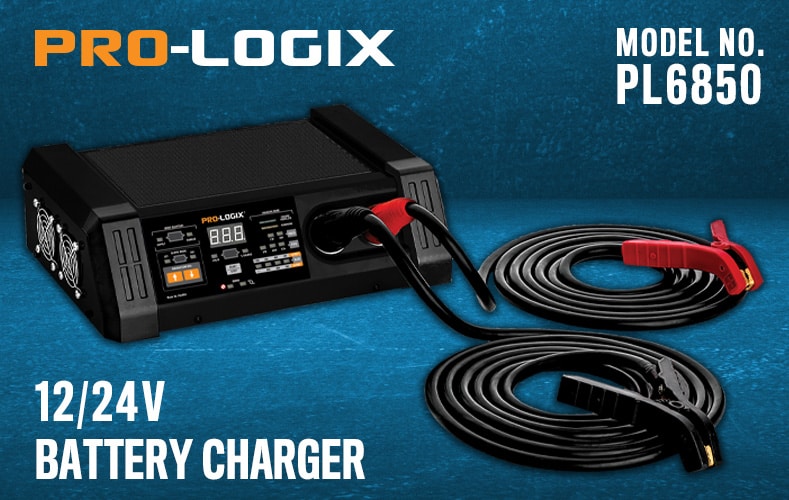
PRO-LOGIX Diagnostic Power Supplies / Battery Chargers tick off all five of the above requirements (and then some) to provide best-in-class programming support. Plus, with two models to choose from, based on your specific shop requirements, you can opt for the model that’s best for your operation.
In power supply mode, PRO-LOGIX Diagnostic Power Supplies provide power to maintain vehicle electrical system voltage at a preset level, increasing or decreasing their amperage output in response to system load changes, to maintain a stable power environment for successful reprogramming. In 12V mode, they feature voltage output support in a range from 13.1-14.9V, adjustable in 0.1V increments, allowing the operator to dial the output in exactly as specified by the supplier of the vehicle under service. They deliver their massive power with minimal voltage ripple (<100mV), providing a clean flow of power to the vehicle without risk of programming interference. They also feature Rapid Load Response (RLR) technology for ultra-quick recovery from changes in system power demand. These two factors combine to deliver an extremely stable electrical environment to the vehicle under service, exactly what’s required when performing module reprogramming, ADAS recalibrations, repairs of electronic vehicle systems and electrical system diagnosis.
A quick note on how the power supply function works, as it comes up often in conversations with shops and technicians. When a technician connects, for instance, the PL6850 to a vehicle, sets the desired voltage level (i.e. 13.7V) and starts a power supply mode operation, the power supply will bring the vehicle’s system/battery to 13.7V and provide whatever current is required to maintain that voltage level. So, even though the PL6850 is capable of providing up to120A in power supply mode, it only provides the current required to maintain the system at the desired level. If that means it needs to output 8A, that’s what it outputs. If it means 92A, that’s what it outputs. So, it supplies only what the system wants, no more, no less.
Here are the details of our two PRO-LOGIX Diagnostic Power Supplies / Battery Charger models:
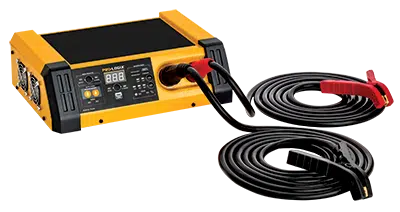
PL6100
12 Volt 100A Power Supply
and 60/40/10A Battery Charger
- 0-100A (on demand) power supply mode to maintain system voltage
- Power supply mode is adjustable from 13.1V-14.9V to match OE specification
- Power supply mode has minimal voltage ripple (<100mV)
- Power supply mode features Rapid Load Response (RLR) technology
- 60/40/10A charging modes allow quick, efficient charging of all battery sizes
- Properly charges Flooded, AGM, Spiral Wound, Deep Cycle Lead Acid and LiFePO4 Lithium Batteries
- Forced start mode allows charging of totally dead batteries
- Battery repair mode overcomes battery sulfation to restore reserve capacity
- Reverse polarity protection and battery fault detection
- Extra-long 13′ cable reach
- PowerJaw clamps provide improved access to hard-to-reach batteries
- PowerJaw clamps allow the hood to be closed (most vehicles) during ADAS calibration
- Requires 20A service

PL6850
12/24 Volt 120A Power Supply
and 100/60/40/10A Battery Charger
- 0-120A (12V, on demand) power supply mode to maintain system voltage
- Power supply mode is adjustable from 13.1V-14.9V to match OE specification
- 0-60A (24V, on demand) power supply mode to maintain system voltage
- Power supply mode is adjustable from 26.2V-29.8V to match OE specification
- Power supply mode has minimal voltage ripple (<100mV)
- Power supply mode features Rapid Load Response (RLR) technology
- 100/60/40/10A 12V charging modes allow quick, efficient charging of all battery and pack sizes
- 60/40/10A 24V charging modes allow quick, efficient charging of all battery and pack sizes
- Properly charges Flooded, AGM, Spiral Wound, Deep Cycle Lead Acid and LiFePO4 Lithium Batteries
- Forced start mode allows charging of totally dead batteries
- Battery repair mode overcomes battery sulfation to restore reserve capacity
- Reverse polarity protection and battery fault detection
- Extra-long 13′ cable reach
- PowerJaw clamps provide improved access to hard-to-reach batteries
- PowerJaw clamps allow the hood to be closed (most vehicles) during ADAS calibration
- Requires 20A service
As vehicles get ever more complex and system updates become an increasingly common component of even routine mechanical repairs and maintenance procedures, a quality power supply becomes an essential tool for busy shops, dealerships and fleet service operations. The above review of what can go wrong when adequate power isn’t available to the vehicle during reflashing, reprogramming and calibration provides a clear case for having the tools and equipment needed to perform these tasks correctly the first time.
*Tanner Brandt is President of Autodiag Clinic, a mobile diagnostic service operation. He is an ASE-certified mobile diagnostic technician and an industry trainer on a wide variety of vehicle application topics. He is a regular collaborator with Clore Automotive across numerous application areas, particularly as it relates to the many issues encountered when delivering reprogramming and reflashing services to foreign and domestic vehicles.
Have you ever had to overcome an aborted reprogramming event in your operation? Are there specific procedures you have implemented to increase your successful outcomes when reflashing and reprogramming? We’re sure your fellow readers would love to hear about it in the comments below.