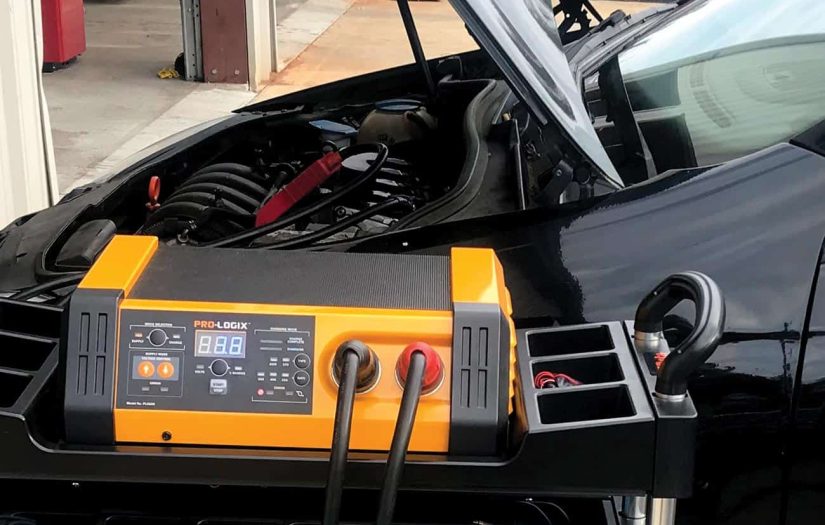
Written in collaboration with our colleague Tanner Brandt.*
This is the third part of what is essentially a 3-part series of articles related to providing vehicle systems with the proper electrical environment to support advanced vehicle systems updates (module reprogramming, module reflashes and ADAS recalibrations). The first part in the series was our annual update to our table of OE-recommended voltage levels for optimal support. The harsh reality is that each manufacturer wants a specific voltage environment, which differs from make to make and even from model to model within makes. This information is often difficult to access, so we brought it together in one handy guide about five years ago, with annual updates since then.
The second installment of the series was a review of the dangers of allowing system voltage to drop below the problem threshold during a reprogramming event. It explained why a programming event or ADAS recalibration can be aborted for this reason and provided several examples of specific manufacturer routines that can go haywire when voltage drops. It also provided some general guidelines of what to do when this occurs. Not wanting to repeat this article’s content here, we highly recommend reading installment 2 before going further on this article, especially the section titled Recovering From an Abortive Voltage Drop. This article is meant to be a companion to that piece.
This third installment in the series provides a breakdown by manufacturer of the best practice for recovering your programming event if the vehicle experiences a voltage drops that causes the event to abort. Obviously, the goal here is 1) get the programming routine back on track and 2.) do everything possible to not have a catastrophic failure that results in a bricked module.
Failed Module Reprogram Recovery Instructions by Manufacturer
When we published installment 2 in this series, we had many requests for greater detail and expanded coverage of vehicle makes and models, in terms of how to get an aborted programming event back on track. So, we created a table similar to our OE-recommended voltage table.
The below table lists best practice for recovering a failed reprogramming event by manufacturer. This table has been assembled in order to provide general guidance that greatly increases the likelihood of recovering the programming event. It is important to note that these steps are a generalized best practice and won’t apply in every case, depending on the specific circumstances of each programming instance (module being programmed, cause of the abort, etc.). But we believe these will be helpful in most cases.
Acura | Leave Key On Attempt with J2534 Legacy App |
Alfa Romeo | Leave Key On Attempt with Mopar Diagnostic Pod |
Audi | Can do either – Turn Key Off or Leave Key On. Attempt again |
BMW | Leave Key On for gateway failures. Turn Key Off, disconnect power 30 seconds all other modules. |
Buick | Turn Key Off, disconnect power 30 seconds. If vehicle is pre-2007, use Cardaq M or similar early J2534 interface |
Cadillac | Turn Key Off, disconnect power 30 seconds. If vehicle is pre-2007, use Cardaq M or similar early J2534 interface |
Chevrolet | Turn Key Off, disconnect power 30 seconds. If vehicle is pre-2007, use Cardaq M or similar early J2534 interface |
Chrysler | Leave Key On Attempt with Mopar Diagnostic Pod |
Dodge | Leave Key On Attempt with Mopar Diagnostic Pod |
Fiat | Leave Key On Attempt with Mopar Diagnostic Pod |
Ford | Leave Key On, attempt again. If unsuccesful, try blank path programming. |
Genesis | Leave Key On Attempt with Factory Android Tablet |
GMC Truck | Turn Key Off, disconnect power 30 seconds. If vehicle is pre-2007, use Cardaq M or similar early J2534 interface |
Honda | Leave Key On Attempt with J2534 Legacy App |
Hyundai | Leave Key On Attempt with Factory Android Tablet |
Infiniti | Leave Key On, attempt again. |
Jaguar | Ford/Fomoco Module – Leave Key On, attempt again. |
Jeep | Leave Key On Attempt with Mopar Diagnostic Pod |
Kia | Leave Key On Attempt with Factory Android Tablet |
Land Rover | Ford/Fomoco Module – Leave Key On, attempt again. |
Lexus | Leave Key On, attempt again. |
Lincoln | Leave Key On, attempt again. If unsuccesful, try blank path programming. |
Mazda | Leave Key On, attempt again. |
Mercedes | Can do either – Turn Key Off or Leave Key On. Attempt again |
Mini | Leave Key On for gateway failures. Turn Key Off, disconnect power 30 seconds all other modules. |
Mitsubishi | Leave Key On, attempt again. |
Nissan | Leave Key On, attempt again. |
Smart | Can do either – Turn Key Off or Leave Key On. Attempt again |
Sprinter | Can do either – Turn Key Off or Leave Key On. Attempt again |
Subaru | Leave key on and allow software to attempt again when prompted. Software will attempt 4-5 times before prompting to turn key off. If module loses power, key off until powered down completely. Attempt again, may take multiple attempts. |
Toyota (except supra) | Leave Key On, attempt again. |
Volkswagen | Can do either – Turn Key Off or Leave Key On. Attempt again |
Volvo | 1. Open Vida -> Software Installation -> Advanced Test 2. Verify that the control module is “Not responding” 3. Disconnect its power supply by removing its fuse(s) or connector NOTE! – There might be more than one fuse that is used to power up a control module. 4. Enable programming mode and immediately reconnect its power supply 5. Verify the control module is in “programming” mode 6. Close the Advanced Test menu by clicking the X in the top right corner – do NOT click “Stop Programming Mode” or “Reset” before exiting. 7. Purchase and install a reload for the control module and answer NO when asked if it was replaced 8. If available, purchase and install the Total Upgrade, Service 2.0, or PDS ** If the control module is “not responding” after step 5, perform steps 1-5 again (please try at least eight times) ** Reference: https://static.nhtsa.gov/odi/tsbs/2023/MC-10241680-9999.pdf |
We have also made this available as a downloadable PDF. The PDF combines the OE-recommended voltage table (page 1) and this table (page 2). Click here to download it.
Aborted Programming Due to Low Voltage - An Avoidable Problem
Programming failures due to low voltage conditions are largely avoidable by using a quality power supply to maintain vehicle system voltage at a specific level throughout the reprogramming event. From our point of view, there are five main factors that go into being a quality power supply:
1.) the power supply provides sufficient power to manage the power needs of a wide variety of make and models, which for us means a minimum of 100A support,
2.) the power supply can provide its maximum power output continuously for as long as a vehicle might require it,
3.) the power supply’s output features low voltage ripple, which is a critical aspect of being a “clean,” stable power supply,
4.) the power supply’s output recovers quickly from changes in vehicle load demand, which is a second critical aspect of being a “clean,” stable power supply,
5.) the power supply can provide a wide range of adjustable voltage support levels, not just a single or low/high voltage support level(s).
Lacking any one of these, for us, is honestly a disqualifier and drops a given unit to B class or lower status.
The case for investing in a quality power supply for this application is very straightforward. First, it is the right tool for the job – designed specifically to support module reprograming/reflashing applications and ADAS recalibration applications. Second, by having the right tool, a shop is well positioned to avoid aborted programming events and the costs associated with them. One bricked module alone could cost more than a shop’s acquisition cost for a quality power supply.
PRO-LOGIX – Best-in-Class Programming Support
PRO-LOGIX Diagnostic Power Supplies / Battery Chargers tick off all five of the above requirements (and then some) to provide best-in-class programming support. Plus, with two models to choose from, based on your specific shop requirements, you can opt for the model that’s best for your operation.
In power supply mode, PRO-LOGIX Diagnostic Power Supplies provide power to maintain vehicle electrical system voltage at a preset level, increasing or decreasing their amperage output in response to system load changes, to maintain a stable power environment for successful reprogramming. In 12V mode, they feature voltage output support in a range from 13.1-14.9V, adjustable in 0.1V increments, allowing the operator to dial the output in exactly as specified by the supplier of the vehicle under service. They deliver their massive power with minimal voltage ripple (<100mV), providing a clean flow of power to the vehicle without risk of programming interference. They also feature Rapid Load Response (RLR) technology for ultra-quick recovery from changes in system power demand. These two factors combine to deliver an extremely stable electrical environment to the vehicle under service, exactly what’s required when performing module reprogramming, ADAS recalibrations, repairs of electronic vehicle systems and electrical system diagnosis.
Here are our two PRO-LOGIX Diagnostic Power Supply / Battery Charger models:
PL6100 12 Volt 100A Power Supply and 60/40/10A Battery Charger
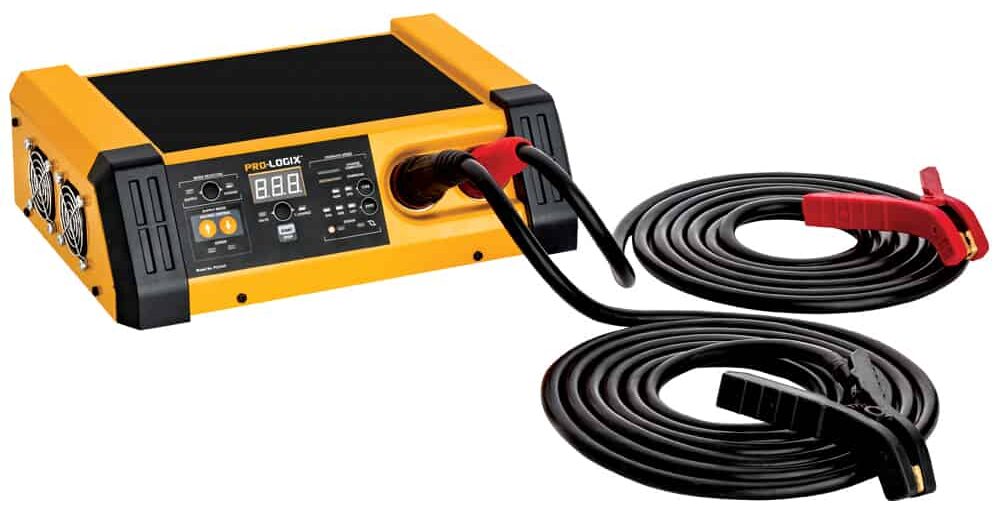
• 0-100A (on demand) power supply mode to maintain system voltage
• 60/40/10A charging modes allow quick, efficient charging of all battery sizes
• Properly charges Flooded, AGM, Spiral Wound, Deep Cycle Lead Acid and LiFePO4 Lithium Batteries
• Forced start mode allows charging of totally dead batteries
• Extra-long 13′ cable reach
• Requires 20A service
PL6850 12/24 Volt 120A Power Supply and 100/60/40/10A Battery Charger

• 0-120A (12V, on demand) power supply mode to maintain system voltage
• Power supply mode is adjustable from 13.1V-14.9V to match OE specification
• 0-60A (24V, on demand) power supply mode to maintain system voltage
• Power supply mode is adjustable from 26.2V-29.8V to match OE specification
• 100/60/40/10A 12V charging modes allow quick, efficient charging of all battery and pack sizes
• 60/40/10A 24V charging modes allow quick, efficient charging of all battery and pack sizes
• Requires 20A service
An aborted programming event or ADAS recalibration doesn’t have to result in a failed module. Of course, an ounce of prevention is worth a pound of cure – starting with a quality power supply that provides optimal system support for these complex tasks takes many potential problems off the table. But, if things do go sideways during your reprogramming routine, we’d suggest consulting the above table as a starting point in your efforts to get things back on track.
*Tanner Brandt is President of Autodiag Clinic, a mobile diagnostic service operation. He is an ASE-certified mobile diagnostic technician and an industry trainer on a wide variety of vehicle application topics. He is a regular collaborator with Clore Automotive across numerous application areas, particularly as it relates to the many issues encountered when delivering reprogramming and reflashing services to foreign and domestic vehicles.
Same questions as last time – have you ever had to overcome an aborted reprogramming event in your operation? Are there specific procedures you have implemented to increase your successful outcomes when reflashing and reprogramming? We’re sure your fellow readers would love to hear about it in the comments below.