

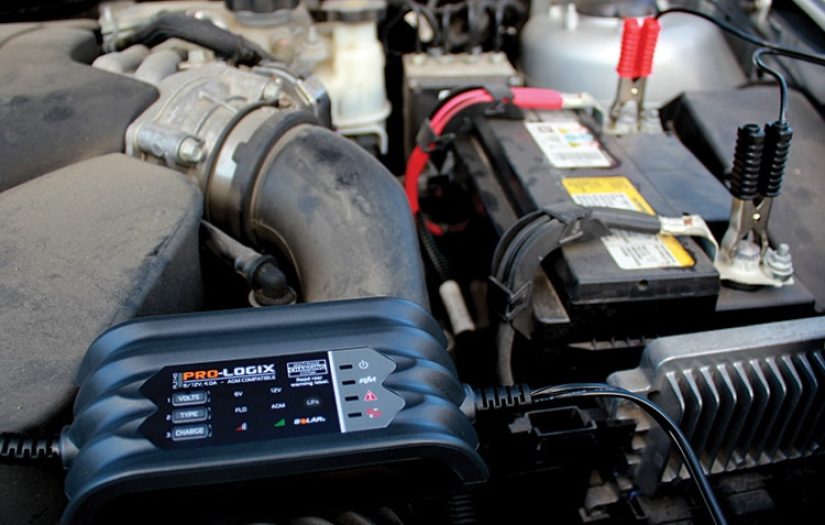
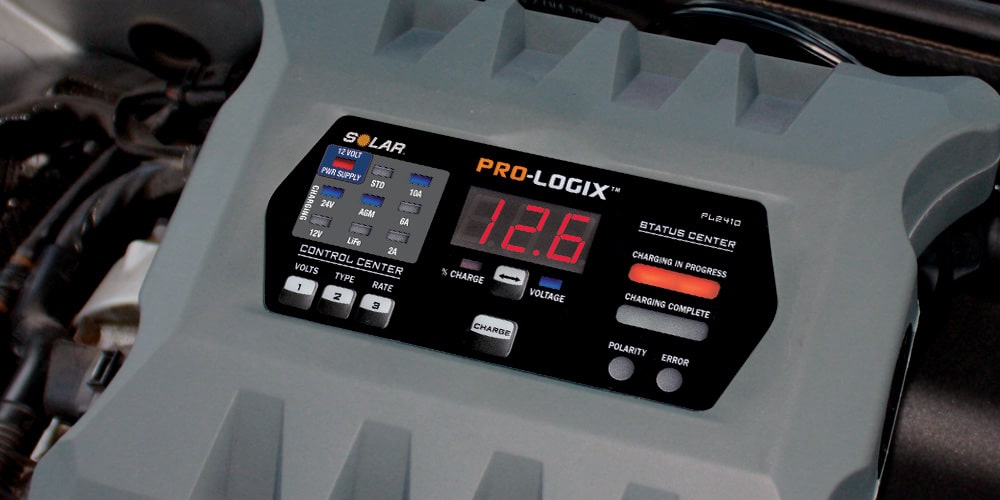
As with charging, where we abandoned the old “volts goes up / amps go down” method with MCU adoption, there is now a much better way to manage batteries under extended charging than the old trickle method. With trickle charging, once the battery has reached full charge, the charger shifts to a maintenance mode where a constant voltage output (usually around 13.1V) is supplied continuously to keep the battery at full charge. We liken this to slivering a few additional electrons onto the battery to keep it from discharging. Frankly, though, we see this as a prehistoric approach. Again, better than nothing, but less than ideal.
With PRO-LOGIX, we most definitely don’t trickle. Instead, we deliver an enhanced maintenance mode to optimize long-term maintenance scenarios in a way that improves battery health and restores battery reserve capacity. As we noted in a previous Deep Dive into our enhanced maintenance mode process, “Upon charge complete, we actually rest the battery for a set period. A known good battery will not self-discharge over the period of a few days. Once the rest period has ended, we then exercise the battery by placing a load on it (simulating the starting event) and follow that up with a new, full charge cycle. This process will repeat for as long as the charger remains connected to the battery.”
In the lab and in the field, we have found that deploying our enhanced maintenance mode extends battery life by more fully activating the battery’s chemistry and more deeply charging the battery. In essence, the PRO-LOGIX maintenance process provides a significant return on the time and effort that you invest in your offseason battery care routine. The enhanced maintenance mode is built into every PRO-LOGIX portable charger and maintainer, from our PL2112 and PL2140 to our PL2320 and PL2410. Try it once and, we believe, you’ll never want to service your batteries any other way.





2 Responses
Temperature compensation in extreme temperature conditions is necessary for wet lead-acid batteries, in my humble opinion.
Thanks Bill. We always appreciate your comments, suggestions and perspective. We couldn’t agree more when it comes to temperature compensation (and most other battery-related topics). We hope you are doing well. Thanks again, Jim